black and white bed linen

ReTile - Waste → Worth

Transforming recycled plastic into high-value interior surfaces.

Modern recycled-plastic products for interiors are still surprisingly limited, despite the growing demand for sustainable materials. Most recycled plastics on the market are of low value, inconsistent in quality, and rarely suitable for high-end interior design. This results in a frustrating gap where designers want circular materials, yet the available options are often inadequate for a confident specification. At the same time, a huge proportion of New Zealand’s HDPE waste continues to be shipped overseas, downcycled, or landfilled, leaving a missed opportunity for local value creation.

With this project, completed as part of the second-year course Waste-Centred Product Design (WCPD), I set out to explore how post-consumer HDPE could be transformed into a high-value product. I believed this could be achieved by designing a product that embraced simplicity, circularity, and material honesty. I wanted a product that highlights recycled plastic rather than disguising it.

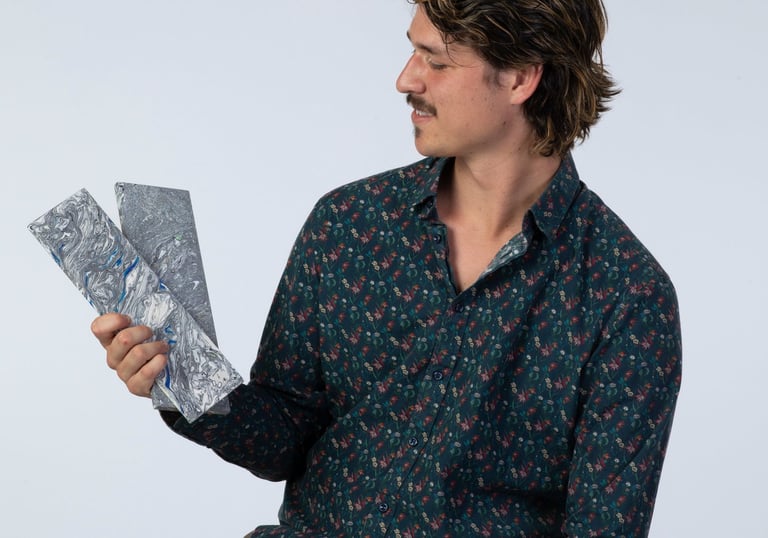
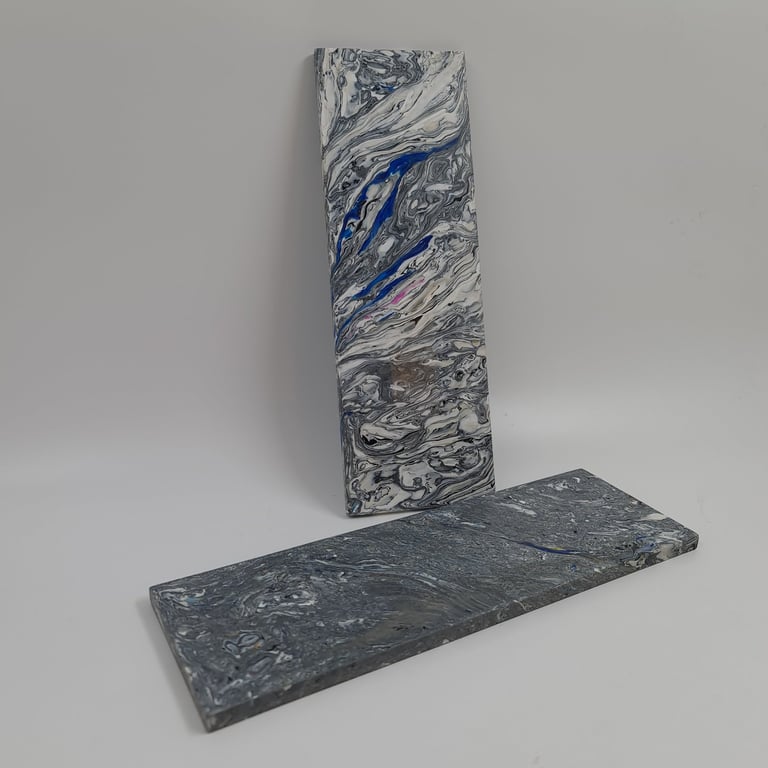
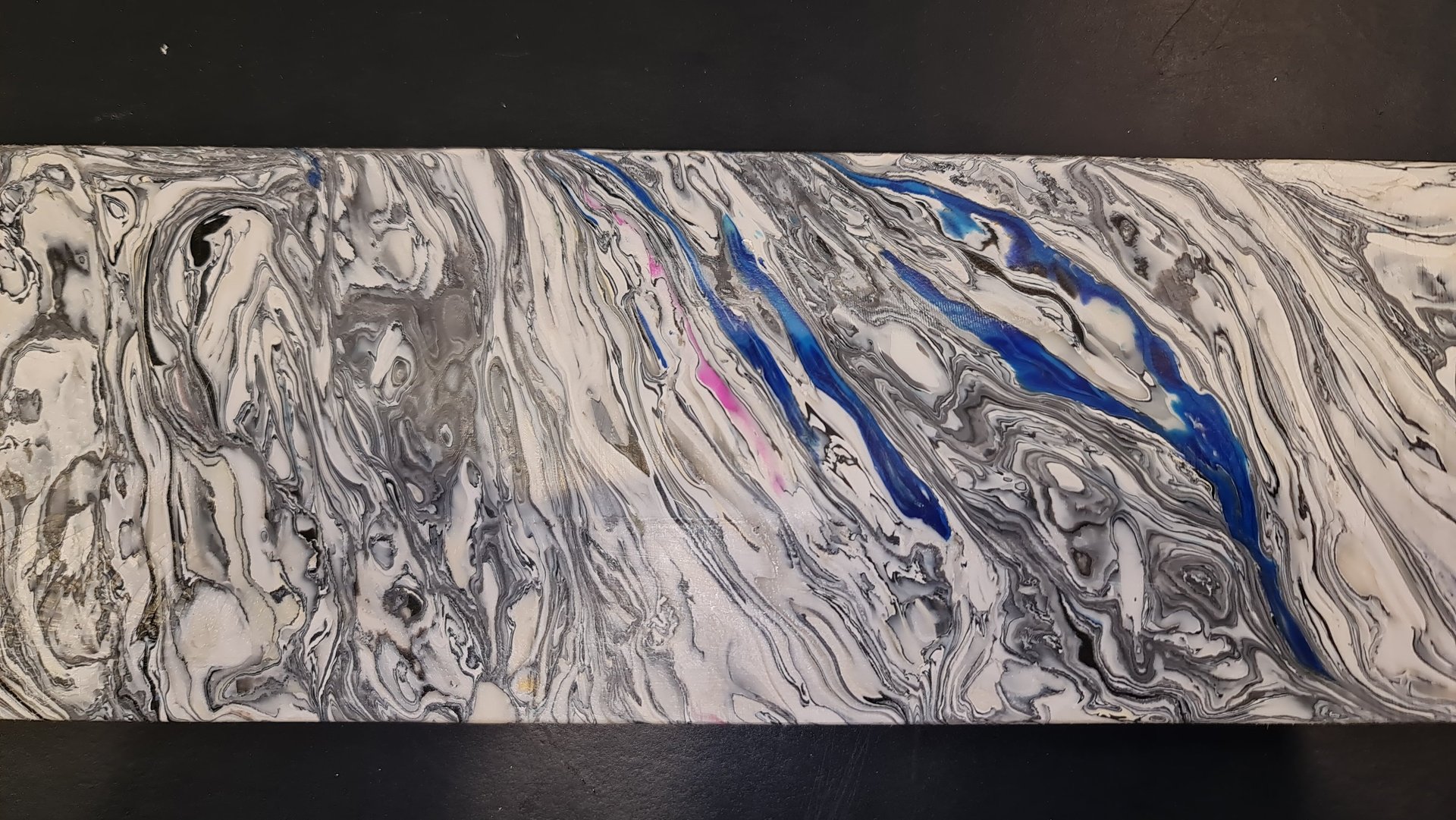
This became ReTile: an investigation into pressing recycled HDPE into durable, marble-like sheets and crafting them into high-quality, fully recyclable interior wall tiles for kitchens & bathrooms. The aim was to demonstrate how thoughtful design and low-tech manufacturing can elevate waste into a desirable yet accessible material system for modern spaces.

IPD 2nd Year Degree Project University of Canterbury Duration: 12 weeks

UCE Summer Start-up Scholarship 24/25 Participant Venture

UC Dragons Den 2023 - 2nd Place

UCE Founder Incubator Programme 25/26

01 - Background

Insights into the project background

Problem

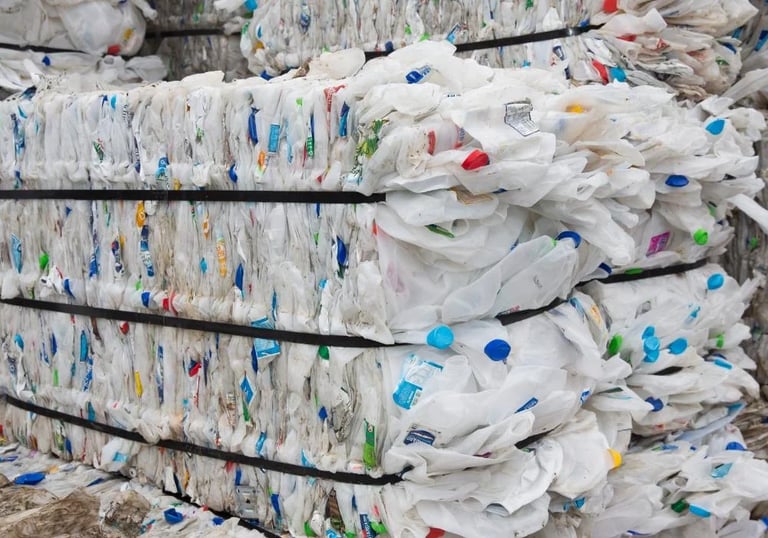
This project focused on two abundant New Zealand waste streams: Type 2 HDPE Plastic and Clay brick Ceramic Waste. Both materials are widely used yet poorly recycled, often downcycled or landfilled despite their remaining value. The aim was to explore how these overlooked resources could be transformed into a high-quality, circular product.

Research
Clay Bricks
  • Commonly sourced from demolition and construction waste.

  • Heavy, brittle, and energy-intensive to manufacture & recycle.

  • Damaged bricks are typically crushed into gravel or used as landfill fill.

  • Limited aesthetic flexibility and inconsistent quality in NZ waste streams.

HDPE (Type 2 Plastic)
  • Abundant in New Zealand (milk bottles, detergents, packaging).

  • Lightweight, non-toxic, and easy to melt, press, and reform.

  • Highly durable and resistant to chemicals and water.

  • NZ’s recycling capacity is limited; much HDPE is still downcycled or exported.

  • High density makes them unsuitable for lightweight interior products.

  • Brittle structure prone to cracking and difficult to machine.

  • Limited form-giving possibilities without heavy industrial processes.

  • Aesthetic options are restricted; colouring requires coatings or dyes.

  • Low melt temp, enabling low-tech forming and pressing.

  • Flexible, impact-resistant, and forgiving during fabrication.

  • Can be easily patterned, allowing aesthetic control.

  • Capable of forming into sheets, tiles, panels, and modular shapes.

Why I Chose HDPE
  • It offers far greater design flexibility than ceramic waste

  • Lightweight and workshop-friendly — ideal for iterative prototyping.

  • Supported strong visual outcomes, including the later marble-like effects.

  • Readily available as a waste stream and meaningful to divert from landfill.

  • Aligned with the project’s goal of creating a high-value, circular interior material.

Insights into the Design & Prototyping

02 - Design & Prototyping and Direction

Original Design

The original design outcome was a garage shelving system made from rHDPE panels. This design direction was chosen for the material’s durability, impact resistance, and moisture tolerance. It also assumed the recycled plastic would look “ugly” or industrial, making a utility application the most appropriate starting point before experimentation shifted the project’s direction.

Prototyping

A 1:3 scale prototype was produced to test the low-tech manufacturing process. This allowed rapid trials of melting, pressing, and forming techniques to validate the concept & the ability to post-press fabricate the material (can be milled, planed, & lasercut)

Nine billets were produced. Each iteration allowed adjustments to melting, pressing, and cooling techniques, gradually improving consistency and visual appeal.

Every iteration came out better, with the last couple achieving the intended gradient direction and colourway determined pre-melt.

03 - Tiles & Business

Decision Time

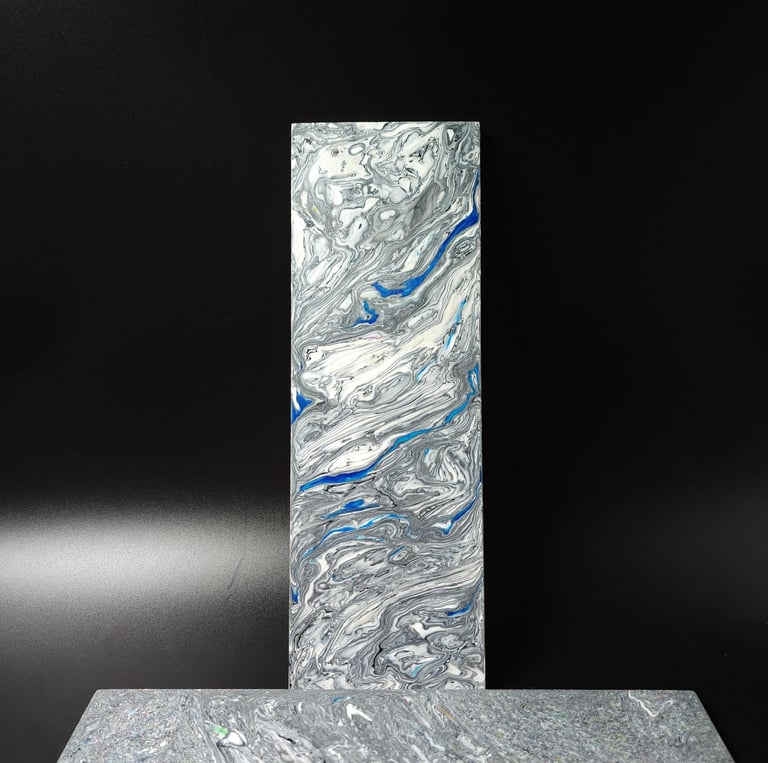
Through manufacturing iterations, we proved that the billets' visual quality improved significantly. We found we could deliberately control the aesthetic outcome by adjusting specific pressing and melting techniques, producing striking, marble-like patterns.

(You can see the improvement in the top image, the top left billet is billet 5, with the bottom right one being billet 8)

The material’s unexpected beauty suggested that it could become a statement wall tile for kitchens and bathrooms. This shift in direction ultimately led to the project being selected for the UC Dragons’ Den competition.

Business

Success at Dragons’ Den hinted that ReTile could have real commercial potential. The strong feedback revealed a clear market interest in high-quality recycled-plastic materials with true aesthetic value.

Motivated by this momentum, I enrolled in the 2024–25 UC Summer Startup Programme to develop ReTile beyond a student project, using the programme’s mentorship and structure to explore manufacturing, validate the market, and begin shaping ReTile into a circular interior-products venture.

The transition to tiles and the decision to start my venture

Now

Following the Summer Startup Programme, meetings with VCs, and mentorship from organisations such as Momentum and The King’s Trust (during my final year of study), I have decided to pause ReTile’s tile production.

To manufacture tiles efficiently enough to achieve a 3× COGS margin, ReTile would require over $250,000 in upfront funding. Securing investment at that scale demands stronger product validation and a clearer manufacturing pathway.

To address this, I am now developing a follow-on project for my capstone year. See my next project to learn how I’m progressing ReTile toward a viable commercial future.